Green Algae and Mold on Siding — NC Causes and Treatment
Why NC humidity drives Gloeocapsa magma, why rinsing doesn't kill it, how often it returns in Raleigh.
Our team at Elite Pressure Washing Raleigh has seen how the fight against exterior buildup is getting harder across Wake County.
A recent 2025 climate report noted that our local area experienced one of its muggiest summers on record, pushing morning humidity to 91 percent.
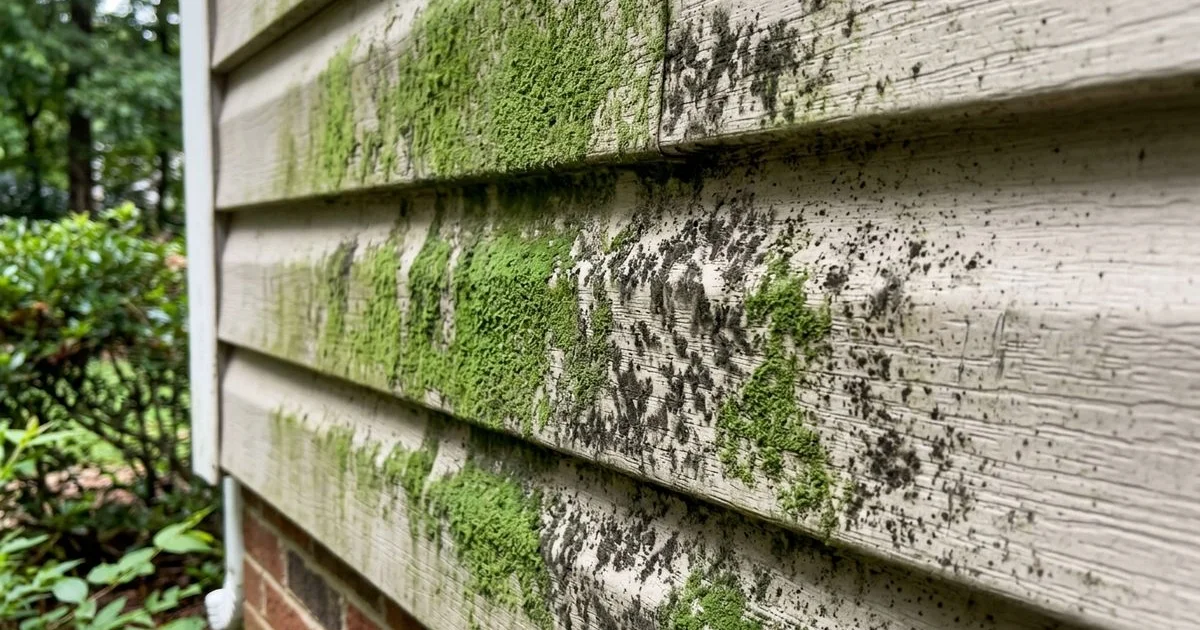
We know this excess moisture is exactly why green algae and mold on siding keep returning faster than you might expect.
The following data explains the environmental factors driving this growth and the exact cleaning methods required to protect your property.
Why NC homes get hit so hard
We constantly battle siding stains because the North Carolina Triangle provides the exact mix of high summer humidity, heavy tree canopy, and a long warm season.
These three environmental triggers create the perfect breeding ground for invasive surface organisms.
Our cleaning crews frequently encounter a specific cyanobacteria called Gloeocapsa magma on local properties.
This microscopic blue-green algae appears as dark streaks and feeds on the limestone filler found in exterior building materials.
We track three specific factors that accelerate mold on house exterior nc:
- High summer humidity keeps our region at 70 to 85 percent relative humidity from June through September.
- Our heavy tree canopies in Raleigh, Cary, and Wake Forest drop year-round organic material that feeds bacteria.
- The local climate provides a seven to eight-month growth window for spores to spread.
We always monitor north-facing walls because they accumulate this biological mass the fastest.
These shaded damp areas rarely see the direct UV sunlight needed to kill surface algae naturally.
Why pressure alone never works
We never rely on standard high-pressure water to remove green algae siding because it only blasts away the visible layer while leaving the microscopic spores intact.
A regular high-PSI rinse forces water into the micro-texture of vinyl, the mortar joints of brick, and the deep pores of stucco.
Our experience shows that these leftover spores simply reactivate the moment the next humid week hits.
Visible algae usually returns to the exterior within 4 to 12 weeks after a basic pressure wash.
We use the following data to explain why blasting your siding is a costly mistake:
| Cleaning Method | Typical Pressure (PSI) | Risk to Vinyl Siding | Root Spore Kill Rate |
|---|---|---|---|
| Standard Pressure Washing | 2,500 - 3,300 | High (Cracking, Water Infiltration) | Low (Only removes visible layer) |
| Professional Soft Washing | Under 100 | Zero (Safe for all siding) | High (Neutralizes spores completely) |
Standard commercial pressure washers output between 2,500 and 3,300 PSI, which is far too aggressive for residential exteriors.
We regularly inspect properties where this aggressive DIY cleaning has caused significant structural issues.
High-pressure water sprayed directly at a wall often forces moisture upward under the overlapping panels.
Our technicians know that vinyl siding is only engineered to withstand a maximum of 1,500 PSI before it risks cracking.
The underlying organism never actually dies, making the harsh pressure treatment entirely futile.
We often see homeowners repeat this frustrating DIY chore every single year because they lack the right chemistry.
This cycle of temporary relief and rapid regrowth drains both your time and your property value.
How soft wash actually solves it
We solve this problem using a specialized soft wash method that applies a sodium hypochlorite solution to kill green algae and mold on siding at the root.
This low-pressure chemical treatment neutralizes the organism completely before safely rinsing away the dead biomass.
Our standard mix utilizes a precise 1 to 2 percent concentration of sodium hypochlorite for residential vinyl walls.
This exact ratio is strong enough to destroy Gloeocapsa magma spores without posing any risk to the building materials or surrounding paint.
We always blend this cleaning agent with a premium biodegradable surfactant.
The thick surfactant allows the mixture to cling vertically to the wall during the critical dwell time.
We follow a strict operational process for house washing on algae-heavy walls:
- A thorough pre-rinse protects your delicate landscaping and foundational plants.
- Our team applies the customized soft-wash mix at a safe, sub-100 PSI pressure level.
- The solution dwells on the surface for 5 to 15 minutes to ensure a complete spore-level kill.
- We execute a gentle, low-pressure rinse starting from the top down to prevent dirty streaks.
- A final landscaping rinse dilutes any remaining soapy runoff into the soil.
We guarantee that this dead biomass will slowly wash away during subsequent rainfalls.
The final result provides 12 to 18 months of a visibly clean exterior before natural regrowth begins.
We know the surrounding environment will eventually redeposit spores onto your property.
This natural 12 to 18-month cycle in Raleigh dictates the ideal schedule for routine exterior maintenance.
Protect Your Property Value Today
We encourage every property owner to take a proactive approach to exterior maintenance before minor stains become major deterioration.
Letting biological growth sit on your siding quietly shortens the lifespan of your exterior materials.
Our experts are ready to safely remove green algae and mold on siding using proven soft-washing techniques.
Contact Elite Pressure Washing Raleigh today to schedule your consultation and restore your home to its original beauty.
Frequently Asked Questions
Why does algae return so fast after a regular pressure wash?
Is the green stuff on my house algae or mold?
Will algae damage my siding?
Learn more about
House WashingLow-pressure soft washing for siding, brick, and stucco — removes dirt, mold, mildew, and pollen without damaging finishes.
Related Guides
How Much Does House Washing Cost in North Carolina?
Typical NC house-wash prices by stories and surface area, add-on costs, what cheap quotes leave out.
House Washing vs Repainting: When to Choose Each
When $400 soft wash gets you years of fresh siding vs $8,000 repaint — visual cues and decision framework.
How Often Should You Wash Your House in North Carolina?
12-18 month cadence for NC homes, what shortens the cycle, signs you're overdue.
Pollen Season House Washing: Why Late Spring Is Optimal in Raleigh
NC pine pollen calendar, why washing during peak shed is wasted, and the late-May window for lasting results.