Gutter Guards vs Regular Cleaning — Which Is Better?
Guard types (mesh, screen, reverse-curve), NC pine-needle limits, cost amortization, when each makes sense.
You know how frustrating it is to invest in home protection only to realize it missed the core problem.
We see this scenario play out constantly across North Carolina properties. The debate over gutter guards vs regular cleaning is not just about simple math.
It really comes down to the specific debris falling on your roof and your long-term property goals. Let’s look at the current data, break down what actually works against local debris, and explore a few practical ways to respond.
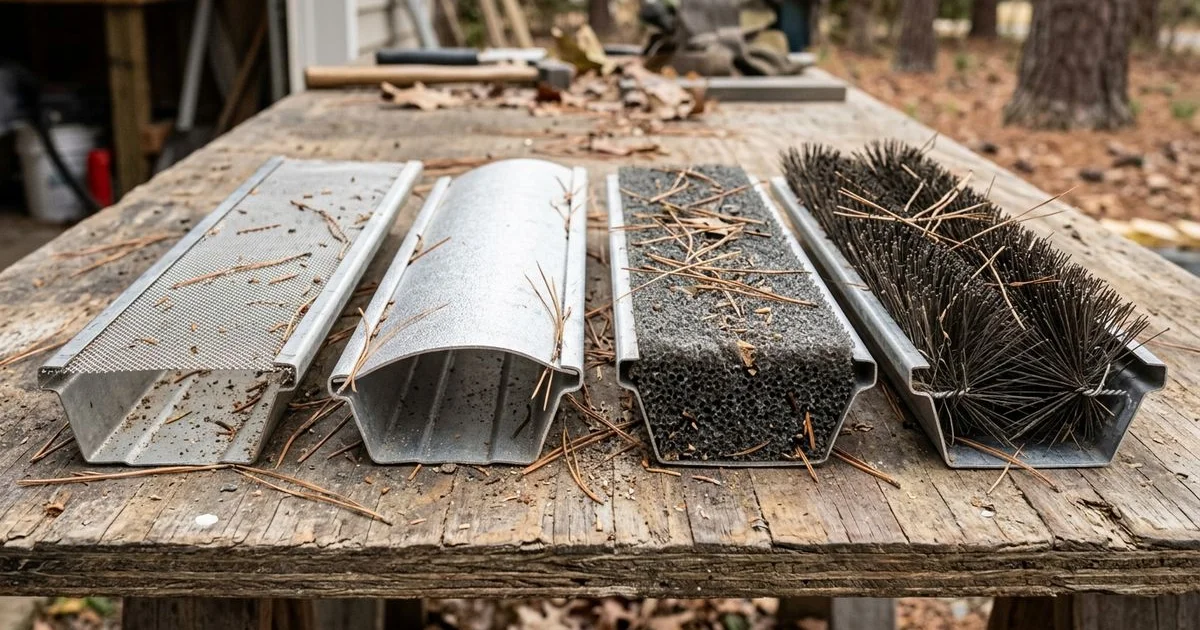
Quick guard taxonomy
Reverse-curve and surgical-grade micro-mesh systems stand out as the only viable options for heavy debris areas. We evaluate dozens of gutter protection systems every year. Finding the best gutter guards nc has to offer requires matching the hardware to the local tree canopy, because most basic products simply cannot handle the sheer volume of North Carolina foliage.
Below is a breakdown of the standard hardware you will encounter.
| Type | Description | NC Effectiveness | Cost |
|---|---|---|---|
| Foam inserts | Foam blocks in gutters | Low: collapse over time | $1-3/ft |
| Mesh / micro-mesh | Fine mesh over gutter | Medium to High: micro-mesh stops needles | $4-12/ft installed |
| Screen | Coarse screen (1/8-inch holes) | Low-medium: leaves still pass | $2-5/ft installed |
| Reverse-curve | Solid lid with surface-tension opening | High: debris falls off | $10-25/ft installed |
| Brush | Long brush in gutter | Low: debris catches in brush | $3-6/ft |
Our team frequently removes failed foam inserts that have completely decomposed from acidic pine tannins. Surgical-grade micro-mesh with 50-micron holes offers a massive upgrade over traditional coarse screens. These tiny apertures physically prevent thin needles from penetrating the system and creating stubborn clogs.
The pine needle reality
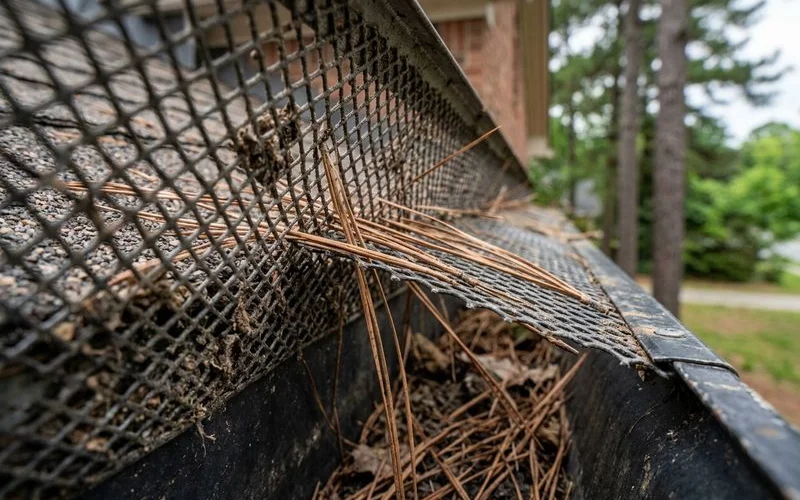
The Loblolly pine, scientifically known as Pinus taeda, creates the single biggest limitation for exterior drainage systems in Raleigh. We pull out interlocking mats of these six-to-ten-inch needles from supposedly protected gutters every week. Their thin, flexible profile allows them to slip right past standard defenses.
A typical standard screen opening is roughly 3,175 microns wide (about 1/8-inch). That dimension provides a massive target for a needle measuring less than a millimeter in diameter. We often find these needles wedged perfectly vertical inside standard screens, acting as a dam for other debris.
Once a few needles slip through, they interlock to form dense mats that block water flow entirely. The failure points span across nearly all traditional hardware options:
- Most mesh hole sizes (1/8-inch and larger) pass needles easily.
- Standard screen openings trap debris vertically.
- Foam channels compact and decay from acidic tannins over time.
- Brush bristles tangle heavily with flexible pine needles.
Even the highest-quality micro-mesh systems still require a quick visual inspection annually. You have to brush the top surface clear so water can enter the channel freely.
Cost amortization
If you are wondering are gutter guards worth it, you need hard numbers to make a confident decision about your property maintenance. We looked at the latest 2026 data from Angi, which shows the average professional gutter cleaning in Raleigh costs between $119 and $234 per visit. A typical home requiring two visits a year costs about $336 annually to maintain.
Our calculations show that a standard $1,500 micro-mesh installation takes about four to five years to break even against professional service rates. High-end reverse-curve systems often cost around $4,000 for a standard residential layout. That premium price tag pushes the break-even point closer to 12 or 15 years.
We advise homeowners to look beyond just the financial payback period. The sheer convenience of never having to schedule routine roof maintenance carries significant value for busy property owners.
Math suggests:
- Short-term cost: Paying a $168 average per cleaning is significantly cheaper for the first few years.
- 10-year cost: Mid-tier mesh installations roughly break even.
- 15+ year cost: Premium reverse-curve systems yield the best return on investment after a decade.
When guards make most sense
Permanent protection systems provide the most value for older adults planning to stay in their homes long-term. According to 2026 CDC data, over 14 million adults aged 65 and older report falling each year. We prioritize these installations because routine ladder work poses a severe and unnecessary risk to your safety. The right hardware also solves several specific architectural challenges across a property.
- Two-story properties: Contractors charge a premium of $1.00 to $1.85 per linear foot for higher rooflines, making routine maintenance much more expensive.
- Heavy Loblolly canopies: Homes surrounded by mature pines require three to four cleanings a year without protection.
- Difficult access points: Steep roof pitches or uneven ground make professional servicing difficult and costly.
- Owners planning to age in place: Eliminating the need to climb ladders is a critical safety upgrade.
When regular cleaning makes most sense
Traditional servicing remains the smartest financial choice for several specific residential situations. We tell clients straight up that not every house needs a multi-thousand-dollar defense system. For instance, a property with no mature trees nearby simply will not generate enough debris to justify a heavy upfront investment. Our crews can clear a single-story home on an open lot in under an hour.
The math strongly favors routine professional visits under these conditions:
- Single-story homes: Professionals can access these structures safely and cheaply.
- Open lot, minimal canopy: A low debris load means you might only need one service visit annually.
- Short-term ownership plans: You will not recoup a $4,000 installation cost if you sell the house within five years.
- Budget-constrained: Spending $168 twice a year is much easier to manage than a large capital expense.
You must remember that even top-tier systems require some minor upkeep. We always remind property owners that micro-mesh screens still need occasional brushing to remove surface dust and pollen. If you prefer a completely hands-off approach, paying for a reliable service contract is often the better route. Whether you choose gutter guards vs regular cleaning, prioritizing a clear drainage system is the best way to protect your foundation. For professional gutter cleaning in Raleigh with or without guards, see the service page.
Frequently Asked Questions
Do gutter guards eliminate cleaning?
Which type works best for pine needle climates?
Is the investment worth it?
Learn more about
Gutter CleaningHand-clearing debris, downspout flushing, and pest removal to prevent fascia rot, foundation pooling, and roof-edge water damage.
Related Guides
Clogged Gutters: Water Damage, Foundation Pooling, and Roof Backups
Water intrusion paths, foundation pooling, NC winter freeze risk, repair-cost comparison.
How Often Should You Clean Your Gutters in Raleigh?
Twice-yearly default (spring + fall), tree-coverage acceleration, NC pine-needle factor.
Signs Your Gutters Need Cleaning
Overflow, plant growth, sagging, animal nests, water stains under gutters — when to call in Raleigh.