Concrete Sealing After Pressure Washing — Is It Worth It?
Acrylic vs penetrating sealer, lifespan extension, stain resistance, cost-per-year math.
You want to make the right call for your home’s exterior.
Many property owners ask if concrete sealing after pressure washing is truly necessary. A freshly washed surface remains highly vulnerable to new stains without a protective barrier.
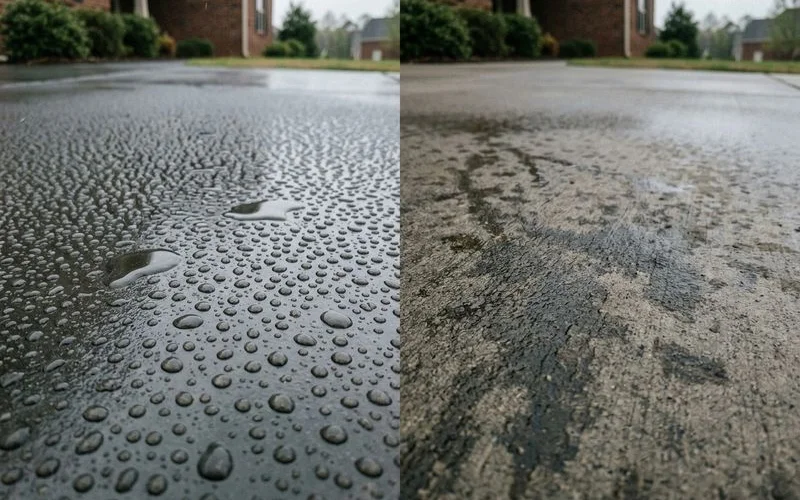
Our team sees the long-term difference a proper coating makes. The raw concrete acts like a giant sponge for motor oil and dirty water. This rapid absorption creates stubborn marks that become harder to remove later.
We use a specific evaluation process before recommending any protective treatments. Let’s look at the actual data behind concrete cleaning and what it means for your property. This guide will break down the exact costs and outline the practical steps to take.
The honest answer on concrete sealing after pressure washing
Our cleaning records show that about 30% of clients add a protective coat after a wash. It is not for everyone, but for the right driveway, it remains a clear win.
Seal when: you have stamped or decorative concrete, sealed before and liked it, want to lock in a fresh clean, or have ongoing stain pressure (sprinkler overspray, multi-car traffic, tree drop).
Skip when: budget-constrained, the driveway is shaded and rarely visible from the street, or you are planning a re-pour or replacement within 3-5 years.
Timing the Application
Timing matters immensely for a successful application. Applying a coat too soon traps moisture inside the slab.
The trapped water dissolves natural salts and pushes them to the surface. This creates a chalky white residue called efflorescence.
We always check the surface conditions closely. New concrete requires a minimum of 28 days to fully cure before receiving a coat. A digital moisture meter should read under 5% before any product touches the surface.
Our technicians prioritize completely dry conditions. Trapped moisture turns clear coatings into a cloudy mess that requires expensive chemical stripping to fix. Scheduling the job during a dry weather window prevents this costly mistake.
Acrylic vs penetrating concrete sealer
Choosing between acrylic and penetrating formulas depends entirely on the finish you want. Acrylics sit on top for a glossy finish, while penetrating liquids soak in for invisible protection.
| Property | Acrylic Sealer | Penetrating Sealer |
|---|---|---|
| Look | Slightly glossy or wet-look | Natural, no sheen |
| Stain resistance | Excellent (top layer) | Very good (in-pore) |
| Slip resistance | Lower (can be slippery wet) | Same as untreated |
| Lifespan | 1-3 years | 5-10 years (Silane-siloxane) |
| Best for | Stamped, colored, decorative | Standard residential driveways |
| Cost | Higher per square foot | Slightly lower |
| Reapplication | Strip and reapply | Add another coat |
Acrylic Sealers (Film-Forming)
Acrylics create a physical barrier on top of the surface. These film-forming products provide excellent resistance against oil spills and leaf stains.
We often recommend this option for decorative surfaces. The clear film enhances the color of stamped or dyed slabs. You will typically get 1 to 3 years of protection before the film begins to wear away or peel.
Penetrating Sealers (Silane-Siloxane)
Penetrating options work entirely inside the pore structure. Products containing silane and siloxane react chemically with the slab itself.
Our preference for standard driveways leans toward these penetrating formulas. The liquid drops below the surface to block moisture from the inside out. A high-quality silane-siloxane product delivers reliable protection for 5 to 10 years without altering the appearance.
We see fewer slip hazards with this invisible barrier. The surface retains its original texture and grip. This makes it much safer for sloped driveways during heavy rain.
Cost-per-year math to seal concrete driveway
Calculating the exact cost per year reveals the true value of surface protection. While the upfront price is higher, the long-term maintenance costs drop significantly.
Recent 2026 data from Angi shows that the national average to seal concrete driveway areas ranges from $1.35 to $2.50 per square foot. This estimated rate covers both the liquid materials and professional labor.
Our local market data provides a clear picture. A typical Raleigh driveway requires a specific budget. Let’s look at the financial breakdown over half a decade.
Unsealed Maintenance Costs
- Annual pressure washing: ~$250/year
- 5-year total expense: $1,250
- Surface condition: Gradually degrades from UV rays and oil absorption
Sealed Maintenance Costs
- Cleaning plus initial application: $250 + $750 = $1,000
- 5-year total expense: $1,000
- Surface condition: Protected, easier to maintain, and looks better year-over-year
We save property owners money by reducing the cleaning frequency. The math favors the protective route when you factor in the extended lifespan of the slab. Stains wipe off the surface rather than absorbing deep into the porous material.
Our clients notice a higher resale appearance as well. A pristine exterior immediately boosts curb appeal for potential buyers. Easy maintenance between professional cleanings keeps the property looking sharp year-round.
When sealing isn’t worth it
Applying a protective coat is not the right choice for every situation. You should save your money if the slab is already failing or slated for removal.
We encounter several scenarios where the treatment provides zero return on investment. Applying liquid over structural problems only wastes time and materials. You need to address underlying issues before focusing on cosmetics.
Common Disqualifiers
- Shaded Locations: The driveway receives no sunlight and remains rarely visible from the street.
- Structural Failure: Significant cracks or concrete failure already exist.
- Deep Porosity: Very old concrete absorbs the liquid unevenly.
- Short Lifespan: You have plans for a full replacement within a few years.
- Curing Issues: Pour-finishing problems that still need to breathe.
The Repair First Rule
We strongly advise repairing damage before applying any liquids. Cracks larger than a quarter inch require structural polyurethane caulk first. A clear coat will not bridge these gaps or stop the slab from shifting.
Our team gives a straight read on whether your specific driveway is a candidate. An honest on-property walk happens before any cleaning ever starts. This transparent assessment ensures you never pay for unnecessary services.
Choosing the best approach for concrete sealing after pressure washing directly protects both your property value and your wallet. Reach out to our crew today to schedule your personalized evaluation and lock in that pristine curb appeal.
Frequently Asked Questions
Acrylic or penetrating sealer — which?
How long does sealer last?
Do I need to clean before sealing?
Learn more about
Concrete & Driveway CleaningSurface-cleaner pressure washing and chemical stain treatment for driveways, patios, walkways, landscape edging, and commercial parking lots.
Related Guides
How Much Does Driveway and Concrete Cleaning Cost in North Carolina?
NC concrete cleaning prices by sq ft, patio/walkway add-ons, sealing cost, multi-surface bundle savings.
How Often Should You Pressure Wash Your Driveway in NC?
Annual baseline for NC driveways, what accelerates grime, why sealing extends the clean.
Removing Oil, Rust, and Efflorescence from Concrete
Stain chemistry by type (hydrocarbon, ferric, calcium), cleaner approach per stain, why pressure alone fails.