Explosion-Proof Vacuum Equipment and Scissor Lift Operations
Class II Division 1 standards, HEPA filtration, aerial lift safety, structural-steel access.
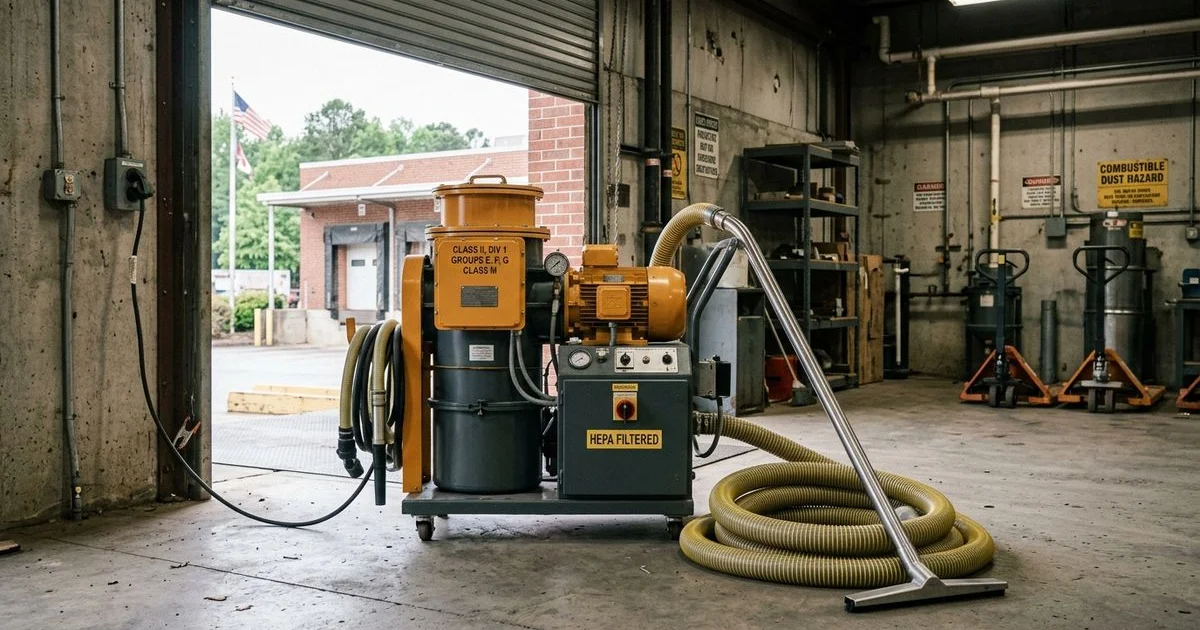
We see exactly how fast dust accumulates in high-reach industrial spaces. Proper facility maintenance utilizing industrial dust removal equipment goes far beyond basic aesthetics.
Keeping your operations safe means following strict rules and ensuring compliant combustible dust removal protocols.
Our team tackles these safety regulations every single day. The data shows that proper equipment selection is the dividing line between a safe facility and a major hazard. Let us review the exact standards, the necessary machinery, and the operational tactics required for success.
What Class II Division 1 means
We define a Class II Division 1 location as an area where combustible dust hangs in the air under normal operating conditions. The National Electrical Code Article 502 outlines strict rules for these hazardous zones.
Using a standard shop vacuum here is a direct code violation.
Our approach relies on certified explosion-proof equipment designed to eliminate any possible ignition source. A prime example is the Ruwac P151EX vacuum, which features a Totally Enclosed Fan-Cooled motor. These specialized machines meet rigorous NEC requirements to keep your building safe.
Our safety engineers look for four mandatory features in these certified units:
- Sealed switches and motors prevent spark-producing electrical contacts.
- Enclosed motor housings stop internal sparks from reaching the ambient dust.
- Our standard operating procedure requires built-in grounding and static dissipation circuits.
- Surface temperatures must stay well below the dust auto-ignition point.
The NEC T3B temperature code caps external equipment surfaces at 329 degrees Fahrenheit to prevent organic dust from catching fire.
Understanding T-Codes and Surface Heat
We always check the specific temperature rating before bringing a vacuum into a classified area. Heat limits are just as critical as spark prevention.
Ignoring these ratings creates an invisible, severe risk of flash fires.
Our equipment audits ensure every machine complies with local fire codes. Certain dusts ignite at surprisingly low temperatures. This makes specialized, certified vacuums absolutely non-negotiable for industrial cleanups.
HEPA filtration and capture
We know that capturing fine particulate matter is critical for indoor air quality. True HEPA-grade filtration traps 99.97 percent of particles down to 0.3 microns.
This efficiency prevents fine dust from being exhausted right back into your breathable air.
Our operations prioritize these systems to guarantee total containment during proper disposal. The Occupational Safety and Health Administration actively targets poor dust management through its National Emphasis Program. Fines for willful or repeated violations jumped to over $165,500 per citation in 2025.
Comparing Standard and Certified Industrial Dust Removal Equipment
We clearly see the differences between standard tools and compliant machinery. Table 1 illustrates why proper filtration is mandatory.
Standard commercial vacuums lack the necessary safeguards for hazardous environments.
| Feature | Standard Shop Vacuum | Class II Div 1 HEPA Vacuum |
|---|---|---|
| Motor Type | Open, prone to sparking | Totally Enclosed Fan-Cooled |
| Filtration | Standard paper or cloth | 99.97% HEPA at 0.3 microns |
| Static Control | None | Fully grounded and dissipative |
| Heat Regulation | Unregulated | Strict T-Code limits applied |
Our crews rely exclusively on a class ii division 1 vacuum equipped with HEPA filters because it is the legally compliant option. A substandard vacuum exhaust easily creates new airborne suspension hazards.
The right equipment guarantees that cleaning efforts do not inadvertently make air-quality conditions worse.
Aerial and scissor lift operations
Our technicians frequently find the heaviest combustible dust buildup in the hardest-to-reach places. Rafters, purlins, girders, and external HVAC ductwork are prime collection zones.
Most of this accumulation happens far above the facility floor.
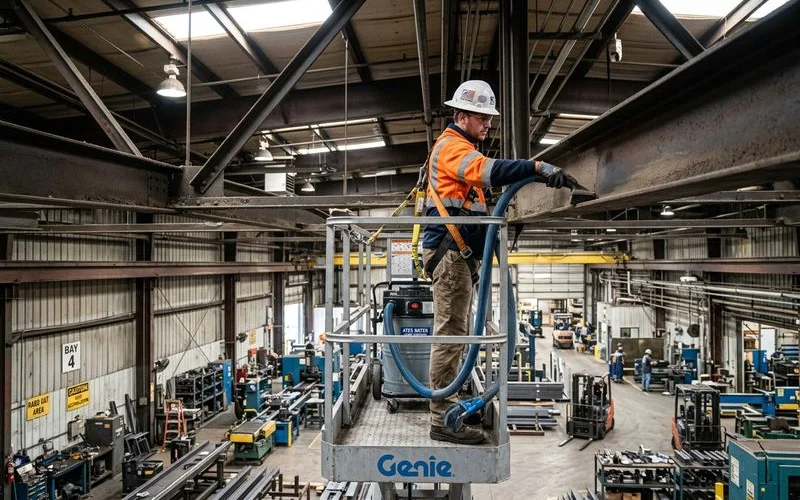
We utilize specialized aerial access equipment to safely reach these high structural components. Scissor lifts easily handle most typical facility heights up to 30 feet. Articulating boom lifts become necessary when operators must span large floor obstructions.
Safe Lift Operation Standards
Our lift operations target several common problem areas overhead. Pipe runs, conduit networks, and industrial light fixtures gather significant debris.
Cable trays and structural steel frameworks require constant attention.
We ensure all operators meet the stringent ANSI A92.24 training requirements updated for 2026. These rules mandate formal instruction for the driver of a Group A Type 3 lift, such as a Genie or JLG model. The updated ANSI A92.22 standard also requires a documented rescue plan and basic safety knowledge for any non-driving occupant in the basket.
Why this combination matters
Our primary goal is completing the necessary cleaning without becoming the ignition source. Combustible dust removal carries immense risk if handled improperly.
The U.S. Chemical Safety Board consistently points to poor housekeeping as a root cause in devastating industrial explosions.
We combine explosion-proof vacuums, HEPA capture, and certified aerial lifts to neutralize these specific risks. This exact equipment triad is what makes overhead cleaning possible in classified locations. Protecting your facility requires uncompromising adherence to these safety standards.
Our dedicated professionals handle explosion proof vacuum, scissor lift, and dust removal operations to secure your building. Dealing with industrial dust removal equipment requires expert knowledge. For facility-grade combustible dust removal work in NC, see the service page or call 919-890-9074.
Frequently Asked Questions
Why can't we use our facility vacuum?
What's the HEPA filtration role?
Can you reach 30-foot ceilings?
Learn more about
High Ceiling & Combustible Dust RemovalNon-invasive, OSHA/NFPA 652-compliant removal of combustible dust from rafters, girders, pipes, and light fixtures using explosion-proof vacuums and aerial lifts.
Related Guides
Sawdust, Coal, and Grain Dust: Combustible Dust Hazards by Industry
Kst / explosibility profiles, accumulation rates, real-incident references, industry housekeeping intervals.
What to Expect from a Professional High Ceiling Dust Removal
Pre-visit walk, EHS coordination, production-shutdown vs phased, dust capture, post-clean documentation.