Sawdust, Coal, and Grain Dust — Combustible Dust Hazards by Industry
Kst / explosibility profiles, accumulation rates, real-incident references, industry housekeeping intervals.
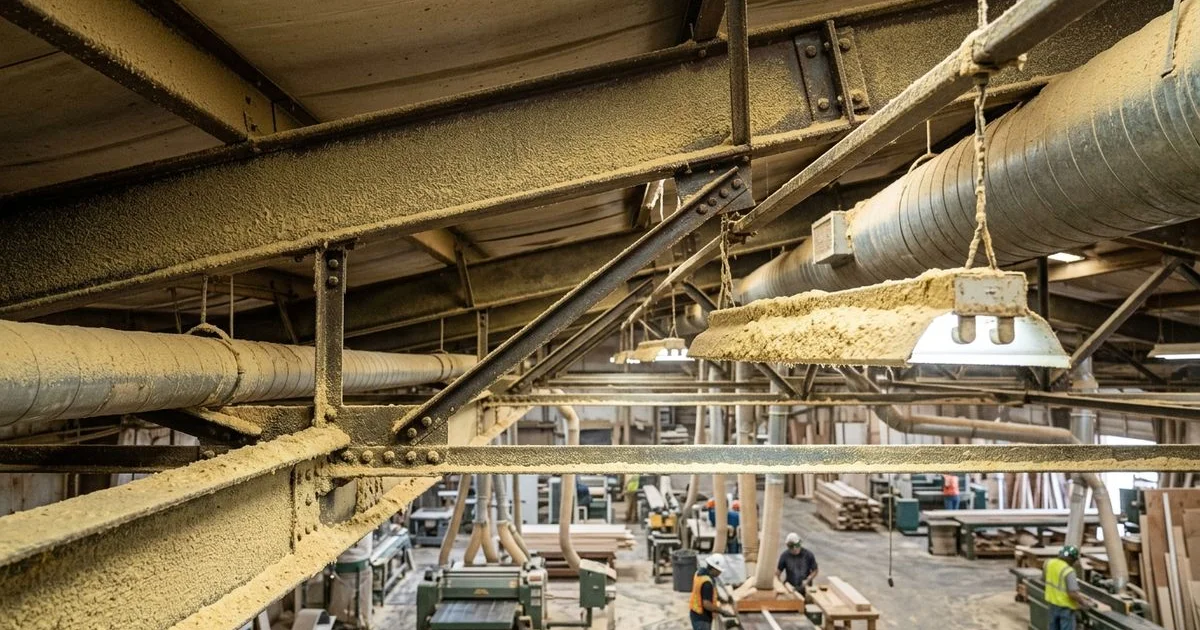
Evaluating combustible dust hazards by industry reveals that industrial dust is a constant battle for facility managers across the US.
We constantly encounter heavy particulate buildup while handling commercial exterior cleaning projects. This daily exposure highlights exactly why proper dust management requires urgent attention.
Our team will break down the specific hazard levels of different dusts and share actionable cleaning intervals to keep your site safe.
Why dust type matters
Different combustible dusts carry distinct Kst values, which directly measure how violently they can explode. The specific hazard profile of your material dictates the exact cleaning intensity and equipment required for your facility.
We rely on these Kst metrics to determine the safest pressure washing and removal tactics for industrial exteriors and ventilation areas. A recent 2026 Agricultural Dust Explosions Report from Purdue University highlighted the severe grain dust hazard in the US, documenting seven explosions in 2025 that resulted in four tragic fatalities.
Our commercial cleaning experience confirms that materials like wheat and corn dust are highly volatile. To put this in perspective, aluminum dust routinely exceeds a Kst of 500, making it the most reactive class you will encounter.
| Dust Type | Industry | Typical Kst | Hazard Notes |
|---|---|---|---|
| Sawdust (softwood) | Wood-working, cabinet | 100-200 | Common explosion source |
| Sawdust (hardwood) | Furniture, flooring | 150-250 | More energetic |
| Grain (wheat, corn) | Milling, food processing | 100-200 | Silo and conveyor hazard |
| Sugar | Food processing | 100-200 | Heat-amplified |
| Coal | Power, processing | 80-200 | Boiler and conveyor zones |
| Plastic / polymer | Injection molding | 100-300 | Fine particle = high reactivity |
| Aluminum / metal | Metal-working | 200-500+ | Most reactive class |
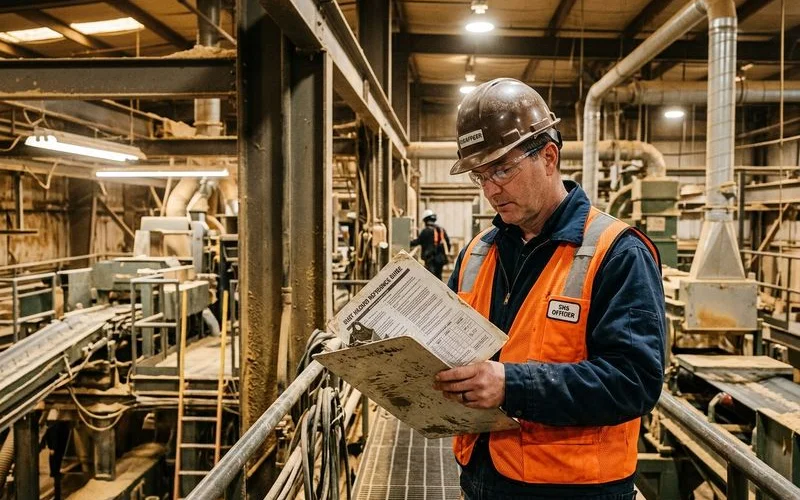
The Kst deflagration index classifies materials based on their explosive power. Data from Dust Safety Science shows that 36% of global combustible dust incidents in recent years involved storage silos.
We always check these hazard ratings before bringing high-powered equipment near a processing site. This statistic proves that confined spaces holding low-Kst materials like grain still pose a massive risk.
The two-explosion problem
Industrial dust events typically happen in two phases, starting with a small ignition and ending in a massive secondary blast. A minor initial spark from electrical friction or static electricity acts as the primary explosion.
We often see neglected rafters and high beams where massive amounts of fuel sit waiting for a shockwave. The primary blast creates a pressure wave that kicks this accumulated dust into suspension.
Our field technicians know that this suspended cloud then ignites, producing the catastrophic secondary explosion that destroys buildings.
- Primary explosion: A small initial ignition caused by electrical faults, friction, or static.
- Secondary explosion: The primary pressure wave suspends accumulated dust, which ignites and creates a catastrophic event.
The US Chemical Safety Board repeatedly warns that secondary explosions cause the vast majority of structural damage and fatalities. Our industry previously relied on NFPA 652 to dictate accumulation control standards.
In 2025, the National Fire Protection Association consolidated these rules into the new NFPA 660 standard. This unified code makes it easier for US facilities to implement strict dust reservoir elimination practices.
We ensure our exterior pressure washing protocols align with these updated standards to prevent secondary cascades. A spotless facility might experience a small primary spark, but the deadly secondary cascade simply cannot happen without suspended fuel.
Accumulation control is the single most effective way to eliminate the dust reservoirs that fuel a secondary explosion.
Industry housekeeping intervals
Required cleaning frequencies range from daily spot-checks to semi-annual deep cleans, depending entirely on your industry and dust generation rate. Woodworking shops face a severe sawdust explosion risk, requiring monthly or post-run cleanups due to rapid accumulation.
We recommend scheduling professional wash-downs during standard maintenance windows to minimize operational downtime. Many US facilities fail OSHA inspections because managers ignore overhead surfaces like rafters and ventilation ducts.
Our teams find heavy buildup on these high, hard-to-reach areas. These zones are exactly where the finest and most reactive particles settle over time.
| Industry | Typical Interval | Drivers |
|---|---|---|
| Wood-working / cabinet | Monthly + post-major-run | Sawdust generation rate |
| Furniture manufacturing | Monthly | Hardwood dust |
| Food processing (grain) | Quarterly | Lower generation but high consequence |
| Sugar processing | Monthly | High Kst + heat |
| Coal handling | Quarterly | Conveyor and storage focus |
| Plastics / injection | Quarterly | Fine particle accumulation |
| Metal-working | Quarterly | Highest Kst class |
| Cement / abrasive | Semi-annual | Lower combustibility |
Proactive cleaning costs significantly less than the massive OSHA fines levied for willful safety violations. Fine polymer particles require strict quarterly cleanups to prevent dangerous reactivity levels.
We frequently help commercial clients who underestimate how quickly plastics and injection molding dust accumulate on exterior vents. You must adjust these standard intervals if your facility increases production volume or changes raw materials.
Documentation requirements
Modern safety regulations require exact records of your Dust Hazard Analysis, cleaning schedules, and incident reports. The shift to NFPA 660 means US facilities now operate under one comprehensive framework for all combustible dust compliance.
We document every step of our combustible dust removal work to ensure you pass insurance audits smoothly. Your housekeeping schedule must clearly show documented intervals and specific personnel accountability.
- Dust Hazard Analysis (DHA): Completed initially and updated periodically under NFPA 660.
- Housekeeping schedule: Documented cleaning intervals and clear accountability.
- Cleaning records: Details on the methods used, cleaning frequency, and equipment certifications.
- Incident reports: Formal documentation of even the most minor spark or event.
OSHA inspectors expect to see detailed methodology and equipment certifications during their site visits. Every minor event requires a formal incident report to track potential safety gaps before they become catastrophic.
Our team provides DHA-aligned scope documentation that covers all these required bases for complete peace of mind. These detailed logs protect your business from liability while keeping your workforce secure.
Managing combustible dust requires constant vigilance and a clear understanding of your specific material risks. Staying ahead of NFPA 660 guidelines protects both your employees and your property investment.
We are dedicated to helping commercial properties maintain safe, compliant exteriors year-round. Reach out to a professional cleaning service today to schedule your next comprehensive facility wash-down.
Frequently Asked Questions
What's the OSHA threshold for combustible dust accumulation?
Does my facility need a Dust Hazard Analysis (DHA)?
How fast does dust accumulate to hazardous levels?
Learn more about
High Ceiling & Combustible Dust RemovalNon-invasive, OSHA/NFPA 652-compliant removal of combustible dust from rafters, girders, pipes, and light fixtures using explosion-proof vacuums and aerial lifts.
Related Guides
Explosion-Proof Vacuum Equipment and Scissor Lift Operations
Class II Division 1 standards, HEPA filtration, aerial lift safety, structural-steel access.
What to Expect from a Professional High Ceiling Dust Removal
Pre-visit walk, EHS coordination, production-shutdown vs phased, dust capture, post-clean documentation.