What to Expect from a Professional High Ceiling Dust Removal
Pre-visit walk, EHS coordination, production-shutdown vs phased, dust capture, post-clean documentation.
We understand that managing overhead combustible dust is one of the most stressful compliance challenges facility managers face. The regulatory landscape across the US is tighter than ever in 2026. OSHA continues to expand its Combustible Dust National Emphasis Program to target manufacturing plants with hazardous accumulations.
Our methodology ensures your facility stays safe without unnecessary downtime. The recently implemented NFPA 660 standard consolidates previous dust regulations, making exact compliance documentation for your ehs combustible dust cleaning strategy mandatory. A thorough industrial dust removal process is your best defense against citations.
We outline exactly what to expect industrial dust removal projects to require before, during, and after the job.
Pre-visit (2-4 weeks ahead)
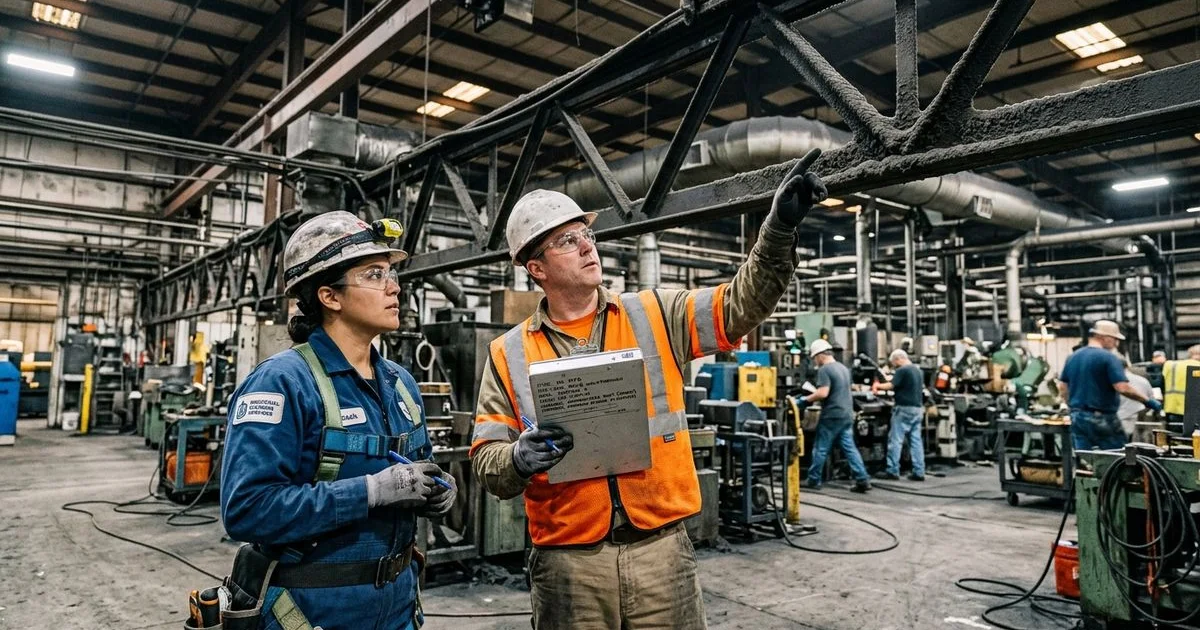
Preparation begins weeks before the actual cleaning date. Proper planning prevents costly interruptions to your production schedule. Our operations lead will conduct a thorough scope walk alongside your environmental health and safety officer.
This initial inspection identifies danger zones where dust accumulation exceeds the OSHA threshold of 1/32 of an inch over five percent of the floor area. Any layer thicker than a standard paperclip poses a significant explosion risk. We gather critical data during this visit to create a compliant action plan.
The pre-visit process includes several vital steps:
- Initial inquiry and scope walk: The facility walk-through maps out the most critical accumulation zones.
- Hazard assessment: The team documents dust types and Kst classifications to align with the new NFPA 660 guidelines.
- Access planning: Production schedules and lift paths are reviewed to minimize workflow disruptions.
- Scope and bid: A written proposal details the exact methodology, equipment, and documentation deliverables.
- Contract and COI: The insurance certificate goes directly to your office for approval.
- Scheduling confirmation: Specific dates, shifts, and isolated zones are locked in.
Day of cleaning
Execution on the cleaning day requires absolute precision. Our crews follow a strict timeline to ensure your facility gets back online safely. The financial impact of unplanned delays is staggering for modern manufacturers.
The 2024 Siemens True Cost of Downtime report reveals that large facilities lose an average of $260,000 per hour when lines stop unexpectedly. We strongly advise scheduling high-ceiling dust removal during planned maintenance windows to avoid these financial hits. A standard phased shift typically follows this schedule:
- 0700: Crew arrival, safety briefing with the facility contact, and equipment unloading.
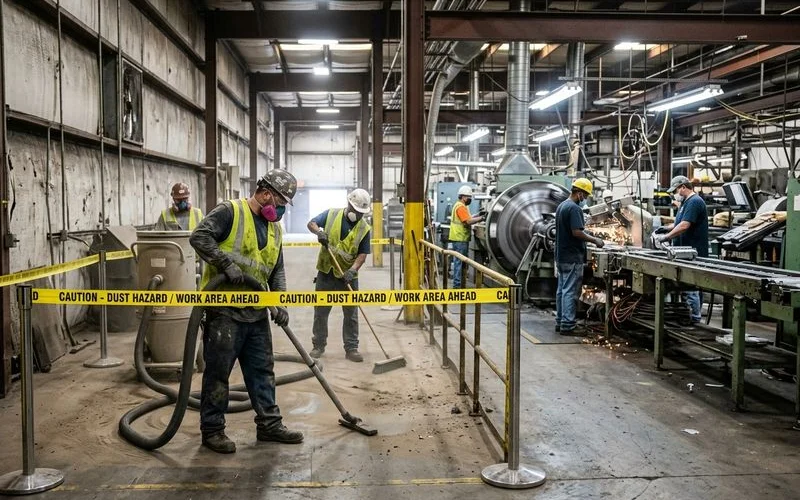
- 0730: Lift positioning, isolation zones marked, and warning signage placed.
- 0800: Systematic vacuum cleaning begins at the highest accumulation points.
- 0800 to 1500: Continuous cleaning, capture, and safe dust disposal into containerized waste units occur within the active zone.
- 1500: A zone completion walk-through happens with your facility contact.
- 1530: The team handles documentation preparation, equipment breakdown, and departure.
Tighter shutdown windows require a different approach. Our project managers deploy multiple crews to compress the timeline and meet aggressive production schedules. This flexibility keeps your plant running profitably.
The entire schedule adapts based on your specific operational constraints.
What you’ll see
Our equipment choices prioritize safety and regulatory compliance above all else. Industrial environments demand specialized gear to handle explosive particulates safely. Standard commercial vacuums can generate static electricity, acting as a deadly ignition source.
We utilize certified explosion-proof machinery to mitigate every possible risk on your factory floor. Here is the exact equipment and methodology you will observe during the project:
- Class II Division 1 vacuum systems: These sealed, explosion-proof units feature HEPA filters rated at 99.995 percent efficiency down to 0.3 microns, pulling over 130 CFM to ensure no sparks are created.
- Scissor or aerial lifts: Operators use certified lifts, remaining properly tied off with fall protection gear alongside a dedicated ground spotter.
- Captured-waste containers: The collected dust stays fully contained in sealed 55-gallon drums rather than becoming aerosolized.
- Isolation zones: Active areas feature clear markings to provide safe pedestrian routing around the worksite.
- No high-energy methods: You will never see compressed air or dry sweeping, as these methods put hazardous dust into suspension and trigger secondary explosions.
Secondary explosions often cause more devastation than the initial spark. Our technicians undergo rigorous training to enforce strict zero-suspension cleaning protocols. Keeping the combustible dust safely contained protects your workers and your building.
The difference between standard cleaning tools and specialized industrial units is massive. We strictly forbid the use of standard commercial vacuums for any combustible dust application. The table below illustrates why this distinction is critical for your facility’s safety.
| Feature | Standard Commercial Vacuum | Class II Division 1 Vacuum |
|---|---|---|
| Filtration Efficiency | 99% at 1.0 microns (Standard HEPA) | 99.995% at 0.3 microns (Absolute HEPA) |
| Static Dissipation | None (High spark risk) | Fully grounded and conductive housing |
| Airflow Performance | 80 to 100 CFM | 130 to 150+ CFM |
| OSHA/NFPA Compliance | Non-compliant for hazardous dust | Fully certified for Class II environments |
Using the right tool prevents regulatory fines and catastrophic facility damage.
After the work
Our administrative team delivers a comprehensive documentation package to prove your compliance once the physical work concludes.
The job is not finished until the final paperwork is in your hands. Commercial insurance providers, such as FM Global, frequently mandate strict evidence of combustible dust management programs.
We ensure you have every document necessary to satisfy an inspector or underwriter. Failing to provide this proof can result in immediate policy cancellations or massive premium hikes.
Your final deliverable package will include the following vital records:
- Before and after photo set: High-resolution images document the exact visual progress by zone.
- Methodology statement: This written summary aligns perfectly with the updated NFPA 660 guidelines.
- Equipment certifications: You receive the exact Class II Division 1 vacuum and HEPA filtration specifications.
- Signed completion form: Your facility contact signs off to verify total satisfaction.
- Scope-of-work documentation: This detailed report is suitable for OSHA, insurance, or Dust Hazard Analysis related audits.
- Recommendation for next cleaning interval: This suggested timeline relies on the specific accumulation patterns observed during the visit.
Our goal is to make this process as straightforward as possible for your management team. Proper records make future safety inspections completely stress-free.
Having clear evidence of proactive maintenance protects your business from liability.
We know that delaying this critical maintenance only increases your operational risk. Taking action today secures your facility for tomorrow.
For facility-grade combustible dust removal across NC, see the service page or call 919-890-9074.
Frequently Asked Questions
Do we need to shut down production?
Who needs to be on-site during the work?
What documentation will we receive?
Learn more about
High Ceiling & Combustible Dust RemovalNon-invasive, OSHA/NFPA 652-compliant removal of combustible dust from rafters, girders, pipes, and light fixtures using explosion-proof vacuums and aerial lifts.
Related Guides
Explosion-Proof Vacuum Equipment and Scissor Lift Operations
Class II Division 1 standards, HEPA filtration, aerial lift safety, structural-steel access.
Sawdust, Coal, and Grain Dust: Combustible Dust Hazards by Industry
Kst / explosibility profiles, accumulation rates, real-incident references, industry housekeeping intervals.